


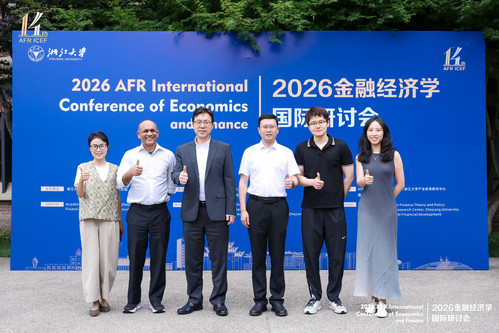
On 12–13 June 2026, the 14th Zhejiang University International Conference on Economics and Finance (2026 International Conference of Economics and Finance) was held at Zhejiang University’s Haining Campus. The conference was jointly organised by the Academy of Financial Research,Zhejiang University (AFR), Financial Institute of Zhejiang Province, the School of Economics at Zhejiang University, the School of Economics at Jiaxing University, and the Qingshan Institute for Advanced Business Studies of Zhejiang University, and was jointly hosted by the AFR Centre for Financial Theory and Policy Research, the Zhejiang University Centre for Industrial Investment Research, and the Jiaxing Institute for Local Financial Development. This year’s forum brought together over a hundred renowned scholars from prestigious overseas institutions such as the Massachusetts Institute of Technology, the National University of Singapore, Washington University in St Louis and The Chinese University of Hong Kong, as well as from leading domestic universities including Tsinghua University, Shanghai Jiao Tong University, Fudan University, Renmin University of China, Harbin Institute of Technology, Wuhan University, Sun Yat-sen University, Xiamen University, Shenzhen University, Central University of Finance and Economics, Shanghai University of Finance and Economics and Southwestern University of Finance and Economics. Participants engaged in in-depth discussions on core topics including macrofinance, financial econometrics, asset pricing and research by early-career scholars, and shared cutting-edge academic developments and the latest research findings.
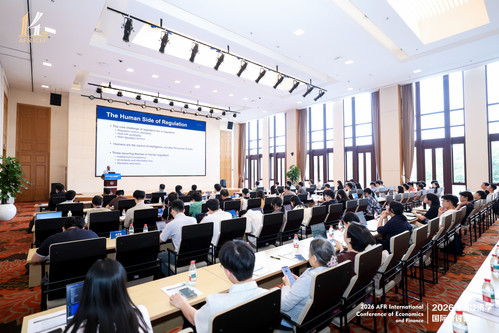
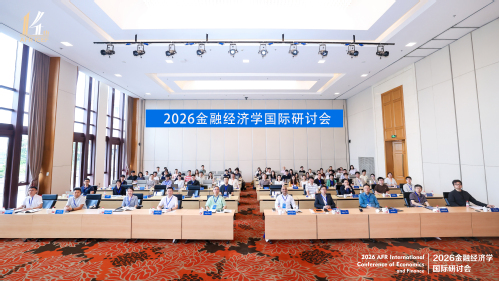
This conference features one main forum and four parallel sessions. The main forum focuses on ‘current academic frontier issues in the fields of macrofinance and economics’, and has specially invited internationally renowned professors and economists to deliver keynote speeches: Sumit Agarwal, the Distinguished Professor at the National University of Singapore Business School and Director of the Sustainable and Green Finance Institute, Chair of the Asian Bureau of Financial and Economic Research (ABFER); Zhou Guofu, Chair Professor of Finance at the Olin Business School, Washington University in St Louis; Chen Hui, Nomura Chair Professor of Finance at the MIT Sloan School of Management and Research Fellow at the National Bureau of Economic Research; as well as over 20 experts and scholars from renowned universities both in China and abroad, who joined the faculty and students in attendance to discuss the latest academic developments and achievements.
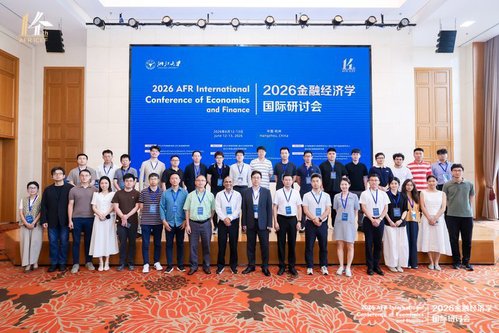
Miao Jianjun, founder of the conference, Qingshan Chair Professor at Zhejiang University, and Dean of the School of Economics and Dean of the AFR, was appointed Honorary Chair of the conference. Zeng Tao, Deputy Dean of the AFR, Wen Yanbing, Vice-President of Jiaxing University, and Shao Hui, Assistant Professor at the Zhejiang University International Joint Business School and Specially Appointed Deputy Dean of the School of Economics, jointly served as Chairs of this year’s conference. The team of Vice-Chairs comprised AFR Research Fellows Xu Qi, Gong Xun, Shen Zhouxiang, Wei Binru and Zhou Wenyu, alongside Hu Jin, Deputy Dean of the School of Economics at Jiaxing University.
Opening Speech: Building on Domestic Practice to Enhance China’s Influence in the Financial Sector
Miao Jianjun, Qingshan Chair Professor at Zhejiang University, Dean of the School of Economics and AFR, delivered an opening speech on behalf of Zhejiang University and the conference organisers. He noted that the International Conference on Financial Economics has been held for fourteen consecutive years and has become a widely recognised platform for academic dialogue in the fields of economics and finance. This year’s conference has brought together leading scholars from around the world to engage in profound discussions on theoretical and empirical issues in macroeconomics and finance. He emphasised that the conference serves not only as an intellectual forum for exploring the frontiers of academic research, but also as a vital platform for grounding research in domestic practice, engaging in global dialogue, and enhancing China’s voice in the field of finance. He expressed his hope that, through this conference, original theories would be developed based on China’s financial practices, thereby establishing an ‘academic landmark’ with international influence; at the same time, he hoped it would build a bridge for mutual learning and exchange, serving as a ‘core hub’ for collaboration amongst universities nationwide, and jointly promoting the high-quality development of China’s financial disciplines.
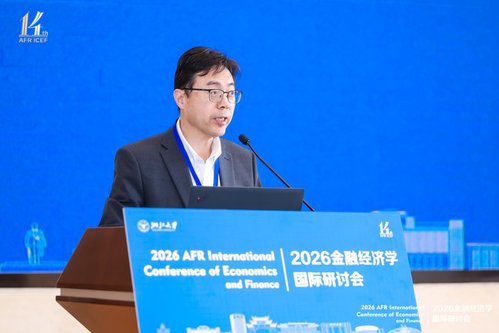
Opening Speech by Professor Miao Jianjun
In his opening speech, Professor Wen Yanbing, Vice-President of Jiaxing University, noted that over the past five years, the School of Economics at Jiaxing University had worked in close collaboration with partners such as the AFR at Zhejiang University and the Finance Institute of Zhejiang Province, sharing a common vision and working in aligned directions, and had together witnessed the increasing development of the ‘International Conference on Economics and Finance’ as an academic platform. Jiaxing University will continue to uphold the principles of openness, cooperation and sharing, further deepening strategic collaboration and resource sharing with all parties, whilst continuously improving the academic ecosystem. Working hand in hand with colleagues from all sectors, the University aims to develop the conference into a leading academic brand with significant international influence and distinct Chinese characteristics, thereby contributing further to the development of a financial discipline system with Chinese characteristics and enhancing China’s voice in global financial governance.
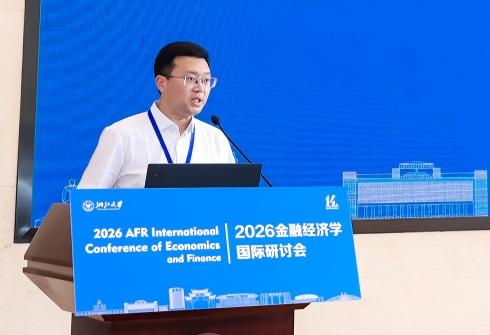
Opening Speech by Professor Wen Yanbing
Keynote Speeches
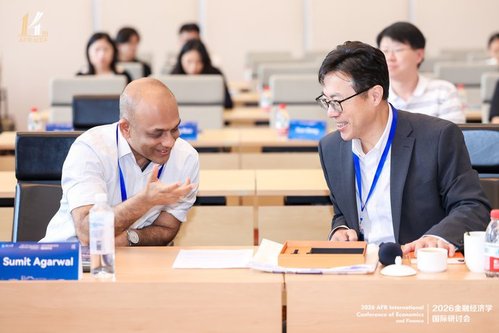
In his keynote speech entitled ‘Humans, Machines, and the Art of Regulation’, Professor Sumit Agarwal discussed human judgement, machine-assisted regulation and the design of regulatory frameworks. He pointed out that the challenges of regulation lie not only in the rules themselves, but also in how they are enforced: different regulatory bodies may produce inconsistent outcomes; a lack of information can lead to defensive regulation; and excessive discretion may amplify decision-making noise. Machines are not intended to replace regulators, but rather to be embedded within regulatory frameworks, serving to establish algorithmic benchmarks, provide hard data anchors and impose weighting constraints. The key to future regulation lies in human-machine collaboration: humans capture contextual and soft information, whilst machines provide consistency, transparency and discipline, thereby reducing systemic volatility whilst preserving regulatory flexibility.
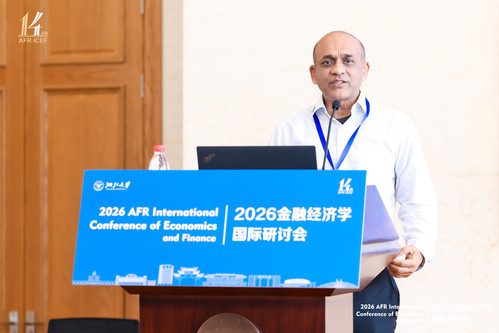
Professor Sumit Agarwal delivered the keynote speech
Professor Zhou Guofu delivered a keynote speech entitled ‘Generative AI, Episodic Factors, and Patent Citation Networks’. He proposed a framework of episodic factors, challenging the assumption of constant and effective factors in traditional asset pricing, and revealed that the role of factors dynamically adjusts in response to changes in the economic environment, thereby enhancing the ability to forecast returns. He also introduced methods for processing corporate numerical features using large language models, promoting the deep integration of artificial intelligence with financial data analysis and improving portfolio performance. Furthermore, based on patent citation networks, he analysed knowledge diffusion between firms and found that indirect knowledge linkages possess a more enduring predictive power for future stock returns. In addition, by comparing market performance during periods when different political parties were in power in the United States using historical data, he pointed out that macroeconomic policy orientations have a greater influence on capital markets than party affiliations.
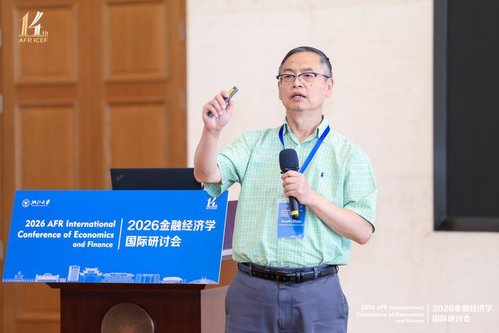
Professor Zhou Guofu delivered the keynote speech
Professor Chen Hui delivered a keynote speech entitled ‘Teaching Economics to the Machines’. He pointed out that economic theory has not lost its value due to advances in data and computing power; on the contrary, it can serve as a priori knowledge, providing structured constraints for machine learning models, and plays a particularly important role in scenarios such as those with limited samples, high levels of noise, and out-of-distribution predictions. He systematically introduced the ‘theory-guided transfer learning’ framework, which involves first using economic theory to generate simulated data for pre-training neural networks, followed by fine-tuning with real data, thereby combining theoretical knowledge with empirical data. Through case studies such as option pricing, macroeconomic forecasting and multi-theory transfer learning, he demonstrated the method’s advantages in terms of predictive accuracy, robustness and generalisation ability. Research indicates that even if theoretical models are not entirely accurate, they can still enhance machine learning performance as long as they capture some of the underlying real-world patterns. He emphasised that the AI era does not mark the ‘end of theory’, but rather a new phase of collaborative innovation between theory and data.
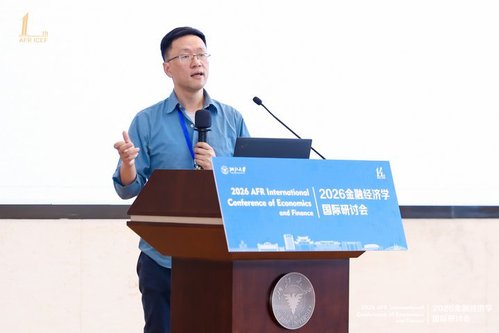
Professor Chen Hui delivered the keynote speech
The main venue was co-chaired by Vice-Dean Zeng Tao and Vice-Dean Hu Jin.
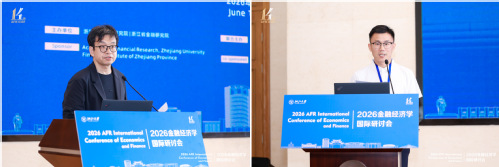
Parallel Sessions: Analysing Financial Frontiers from Multiple Perspectives
On 13 June, the conference hosted four concurrent thematic academic parallel sessions, focusing on ‘Macrofinance’, ‘Financial Econometrics’, ‘Asset Pricing’ and a ‘PhD Students’ Session’. Associate Professors Gong Xun, Zeng Tao and Xu Qi, and Research Fellow Wei Binru served as chairs of the respective sessions. In each session, participating scholars engaged in profound discussions on frontier topics. The atmosphere was one of intense academic engagement, with debates proving both vibrant and constructive. The scholars’ rigorous scholarly approach and their commitment to truth and practicality not only demonstrated the high standard of research within the field of finance but also provided valuable inspiration for the further development and expansion of future research.
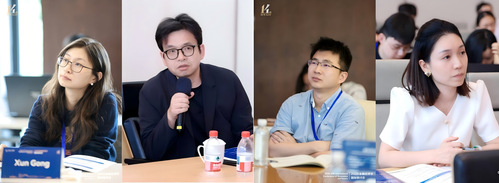
Parallel Session 1: Macrofinance
Feng Xiangyu, Associate Professor at the Macroeconomic Research Center of Xiamen University, delivered a keynote speech titled Old is Gold: Capital Upgrading with Lagged Profit Realization. The study examines capital upgrading, defined as the transition of firms from old equipment and legacy technologies to more advanced, capital- and skill-intensive new capital vintages. The paper utilizes data from the CHAT (Cross-Country Historical Adoption of Technology) dataset, manufacturing export shares, and tariff reductions from the GATT Tokyo Round to identify exogenous demand shocks. The results show that following tariff reductions, the output of new capital goods relative to old capital goods declines in countries with higher demand exposure, indicating that demand expansion may delay upgrading in the short run. The reason is that the returns on new capital are lagged, and its adoption and adjustment costs are high; to rapidly respond to demand, firms are more inclined to continue using old capital.
Li Wei, Associate Research Fellow at the Shanghai Advanced Institute of Finance, Shanghai Jiao Tong University, delivered a keynote speech titled Monetary Trends Without Stars. The study investigates the reference role of the natural rate of interest ($r^*$) in monetary policy, pointing out that long-term shifts in global interest rates cannot be simply attributed to market re-estimations of $r^*$ or macroeconomic fundamentals. The paper identifies monetary policy shocks by leveraging high-frequency yield movements within policy announcement windows such as the FOMC, and decomposes bond yields to separate fundamental signals from policy effects. The research finds that policy announcements can trigger long-term, persistent changes in interest rates. Furthermore, despite the presence of capital controls, Chinese bond markets and offshore RMB markets still experience significant spillover effects; policy communication, investor learning, and the global financial cycle jointly shape interest rate trajectories.
Liu Yilei, Assistant Professor at the Institute of Chinese Financial Studies, Southwestern University of Finance and Economics, delivered a keynote speech titled Central Bank Digital Currency in Developing Countries. The study explores the optimal design of Central Bank Digital Currencies (CBDCs) in developing countries, focusing on their impacts on payment efficiency, financial inclusion, bank investment, and social welfare. The paper constructs a monetary search model that incorporates cash, CBDC, and bank deposits, characterizing residents' unbanked costs and merchants' payment acceptance decisions. The research finds that CBDCs can expand the payment options for unbanked individuals and enhance transaction efficiency; however, if the interest paid on CBDCs is too high, it may crowd out cash and deposits, thereby weakening bank investment. Its welfare effects depend on changes in transaction surplus, unbanked costs, and bank investment, requiring prudent design in combination with inflation, fiscal, and financial structures.
Li Zehao, Assistant Professor at the Shenzhen Audencia Financial Technology Institute of Shenzhen University and the School of Management and Economics of The Chinese University of Hong Kong (Shenzhen), delivered a keynote speech titled Shadow rate under falling stars. The study examines how to more accurately measure unconventional monetary policy stances against the backdrop of a prolonged low-interest-rate environment. The paper points out that the traditional Wu-Xia shadow rate model assumes stationary state variables, thereby ignoring the long-term downward trends of the natural rate of interest and forward rates. The author introduces a trend-stationary interest rate process into the shadow rate framework while controlling for forward curves, risk premiums, and the zero lower bound. The results show that during the Global Financial Crisis and the COVID-19 pandemic, the shadow rates estimated by the new model were lower, indicating that traditional models may underestimate the degree of policy easing. Trend changes in interest rates should be integrated into the measurement of policy stances.
Shen Zhouxiang, "Hundred Talents Program" Research Fellow at the School of Economics and AFR Researcher of Zhejiang University, delivered a keynote speech titled China’s Online Banking and Syndicated Loan Policy. The study investigates whether the expansion of online banking brings systemic financial risks, as well as the regulatory design of minimum retention requirements in syndicated loans. Focusing on 9 online banks in China, the paper constructs a dynamic general equilibrium model that includes online banks, traditional banks, the household sector, and syndicated loan mechanisms. Online banks possess advantages in loan screening and risk control, while traditional banks hold advantages in financing; the two cooperate through syndicated loans. However, the balance sheets of online banks are relatively fragile, and shocks can be transmitted to traditional banks through risk exposure, asset prices, and general equilibrium channels, with bank runs further amplifying the risks. The study concludes that the 30% retention requirement is close to the social optimum.
Parallel Session 2: Financial Econometrics
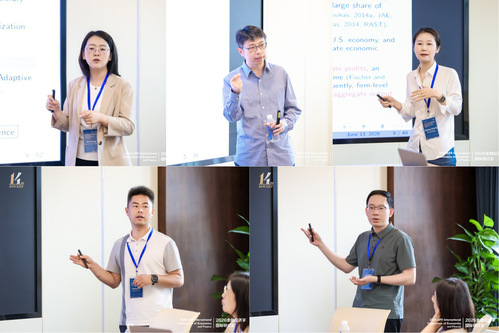
Wang Xia, Professor at the School of Economics, Renmin University of China, delivered a keynote speech titled Three-Dimensional Factor Augmented Regularized Model. The presentation centered on high-dimensional forecasting problems in three-dimensional panel data. The study incorporates a global factor and two types of local factors simultaneously into a target variable forecasting framework, utilizing Principal Component Analysis (PCA) to extract latent common structures from multidimensional data, and combining it with the Adaptive Group LASSO method to address high-dimensional variable selection in forecasting equations. This model captures common fluctuations at the macroeconomic level while preserving local heterogeneity across different dimensions, providing a new econometric tool for dimensionality reduction, modeling, and forecasting of complex economic and financial data. The report demonstrates that against the backdrop of rapid growth in multidimensional data, the combination of factor models and regularization methods helps enhance forecasting accuracy and model interpretability.
Shi Zhentao, Professor at the Department of Economics, The Chinese University of Hong Kong, delivered a keynote speech titled Bagging the Network. The presentation systematically introduced estimation and inference problems in two-sided network formation models. Addressing network data that include individual fixed effects, the study proposes a unified estimation framework applicable to non-transferable utility networks. To tackle challenges such as high-dimensional fixed effects, two-sided consent mechanisms, and non-concave likelihood functions, the paper combines initial values from method of moments, Le Cam's one-step correction, and a split-network jackknife bagging method to effectively correct for incidental parameter bias while maintaining estimation efficiency. This research not only extends the theoretical methodologies of network econometrics, but also provides a new empirical tool for understanding network formation mechanisms in social relationships, risk sharing, wealth disparities, and group interactions.
Huang Naijing, Professor at the School of Economics, Central University of Finance and Economics, delivered a keynote speech titled From Micro to Macro: Learning Real-Time Economic Signals from Firm-Level Accounting Data. The presentation explored how to extract real-time macroeconomic signals from firm-level micro-accounting data. Breaking away from the traditional macroeconomic forecasting approach that relies on aggregate indicators, the study directly utilizes the financial information of more than 20,000 U.S. listed companies and leverages machine learning methods to perform real-time forecasting of total U.S. output. The results show that preserving firm heterogeneity and inter-firm information structures can significantly improve the accuracy of GDP nowcasting. This research indicates that firm-level operational data can not only reflect individual performance, but also serve as an important window for observing macroeconomic trends, providing a new data foundation for policy evaluation and market analysis.
Liu Cheng, Professor at the Economics and Management School, Wuhan University, delivered a keynote speech titled A Multi-Step Approach for Integrated Covariance Matrix Estimation with High-Frequency Data. The presentation focused on the problem of integrated covariance matrix estimation using high-frequency financial data. High-frequency trading prices are often contaminated by market microstructure noise, which may exhibit autocorrelation and cross-sectional correlation, causing traditional estimation methods to suffer from biases in finite samples. This study proposes a multi-step estimation approach that improves the finite-sample performance of pre-averaging methods in real data by jointly correcting the integrated covariance matrix and the long-run covariance matrix of the noise. The report provides a more refined econometric methodology for high-frequency risk measurement, portfolio management, and financial market stability analysis, demonstrating the practical value of high-frequency financial econometrics in real-world financial decision-making.
Liu Xiaobin, Associate Professor at Lingnan College, Sun Yat-sen University and AFR Researcher, delivered a keynote speech titled Seeing Sentiment: News Images, Retail Participation, and Chinese A-Share Index Returns. Breaking through the limitations of previous financial news research that heavily favored textual content, this study utilizes news articles and images from Sina Finance spanning from 2014 to 2026 to construct image pessimism and text pessimism indicators, respectively. The results show that both types of sentiment provide predictive information for short-term returns. However, this predictive power is not universal; instead, it is concentrated in the ChiNext market, where retail participation is higher and arbitrage constraints are stronger, and it is significantly amplified during high-volatility periods.
Parallel Session 3: Asset Pricing
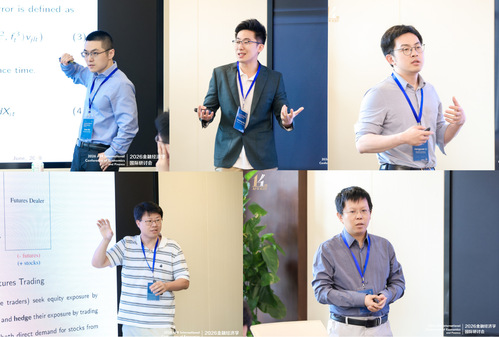
Shi Zhan, Associate Professor at the PBC School of Finance, Tsinghua University, delivered a keynote speech titled Yield Curve Arbitrage in the Credit Market. The presentation centered on the challenges of estimating issuer-specific yield curves in the corporate bond market, proposing a methodology that utilizes information from the bonds of similar firms to construct these curves. A relative value signal is then developed based on the deviation between market yields and the curve-implied yields. The report further analyzes the predictive power of this signal for future corporate bond returns, as well as its relationship with market mispricing, liquidity, and limits to arbitrage.
Gao Junxiong, Assistant Professor at the Shanghai Advanced Institute of Finance, Shanghai Jiao Tong University, delivered a keynote speech titled Electoral Discipline, Economic Growth and Asset Prices. Based on Gallup presidential approval ratings, the study constructs an electoral pressure indicator to measure the strength of electoral discipline under different political states. The report examines the relationships between this indicator and U.S. economic growth, consumption growth, fiscal expenditures, political uncertainty, and stock excess returns. It further analyzes how electoral pressure influences the macroeconomy and asset prices by constraining government rent-seeking and fiscal behaviors.
Li Jiangyuan, Associate Professor at the School of Finance, Shanghai University of Finance and Economics, delivered a keynote speech titled The Zero-Sum Game of Mutual Fund Marketing. Setting the study in the context of mutual fund companies' social media live streaming, the research analyzes the impact of live-stream marketing on fund inflows and fund company revenues. The report finds that while live streaming increases fund inflows into the recommended funds, the overall capital and fee revenue of the fund management company do not increase simultaneously. This indicates that live streaming primarily drives the reallocation of capital within the same fund company. The study also analyzes fund companies' strategic use of live streaming for investor retention and market share defense.
Zhou Ti, Associate Professor at the School of Management and Economics, Harbin Institute of Technology (Shenzhen), delivered a keynote speech titled Implied Volatility Spreads and Stock Market Return Predictability in China: Informed Trading or Liquidity Demand? Focusing on SSE 50 ETF options, the study examines the informational content of the difference in implied volatility between call and put options. The report finds that the implied volatility spread negatively predicts future ETF returns at both weekly and monthly horizons, and further analyzes its relationships with the option-cash basis, liquidity demand, and trading pressure in the options market.
Zhu Yifang, Associate Professor at the School of Finance, Central University of Finance and Economics, delivered a keynote speech titled Beyond L1: Double L0 Regularization in Testing New Factors. The study addresses the problem of factor selection against the backdrop of an ever-increasing number of candidate factors in asset pricing. It introduces a double L0 regularization method within a stochastic discount factor (SDF) framework to identify pricing factors with cross-sectional explanatory power from a vast pool of candidate factors. The report further analyzes the application of this method in mitigating omitted variable bias, factor selection, and model comparison.
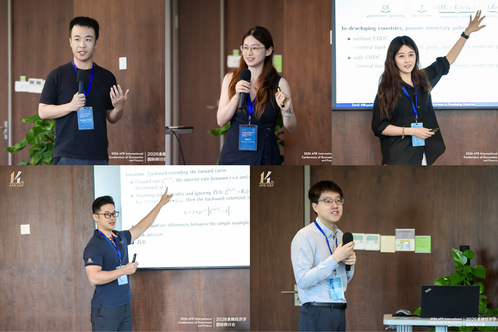
Parallel Session 4: ‘PhD Students’ Session
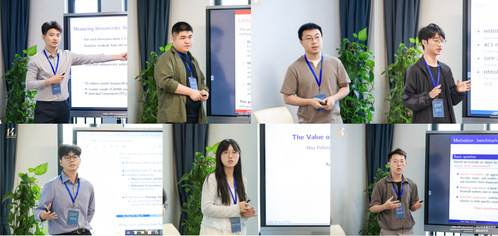
Wu Fenglin from the Shanghai Advanced Institute of Finance at Shanghai Jiao Tong University, Liu Shuaichen from the College and Graduate School of Arts & Sciences at the University of Virginia, Wang Huihui from the School of Economics at Zhejiang University, Lei Yuqin from the PBC School of Finance at Tsinghua University, Wu Yuezhi from the School of Management at Fudan University, Zhang Yichuan from the School of Government at Sun Yat-sen University, and Hou Xiyao from the School of Management at Zhejiang University delivered keynote speeches titled Common Idiosyncratic Volatility in Cryptocurrencies, Policy History, Coupon Stocks, and Mortgage Transmission at the ELB, Corporate Leverage Responses to Capital Controls: International Evidence, Refundable Tax Credits and Mortgage Credit Access: Evidence from State EITC Expansions, Housing Crash, Gold Rush, When the Sky Turns Transparent: Pollution Information Disclosure and the Scientists' Research Behavior, and Benchmark-Relative Tail Risk: An Axiomatic Theory with Applications, respectively.
Background to the conference
As an international conference series of Zhejiang University officially approved by the Ministry of Education, the International Conference on Economics and Finance(AFR ICEF) has been successfully held for 14 consecutive years. The conference has consistently focused on cutting-edge topics in macroeconomic and financial theory as well as empirical research, dedicating itself to building an academic bridge for in-depth dialogue between Chinese and foreign scholars. Past conferences have invited Nobel Laureate in Economics Professor Lars Hansen, along with internationally renowned scholars such as Harald Uhlig, Larry Christiano, Vincenzo Quadrini, Yuliy Sannikov, Jess Benhabib, John Leahy, Gianluca Violante, Russell W. Cooper, and Jonathan Newton, as well as distinguished Chinese economists including Zha Tao, Wang Neng, He Zhiguo, Yu Jianfeng, Wang Pengfei, and Pan Jun to deliver speeches, gaining a widespread reputation in both domestic and international academia. Continuing its tradition of being high-level and open-ended, this year's conference gathers domestic and overseas experts and scholars to explore the frontiers together, injecting new momentum into promoting the high-quality development of China's financial discipline and enhancing China's voice in the global field of financial academics.