


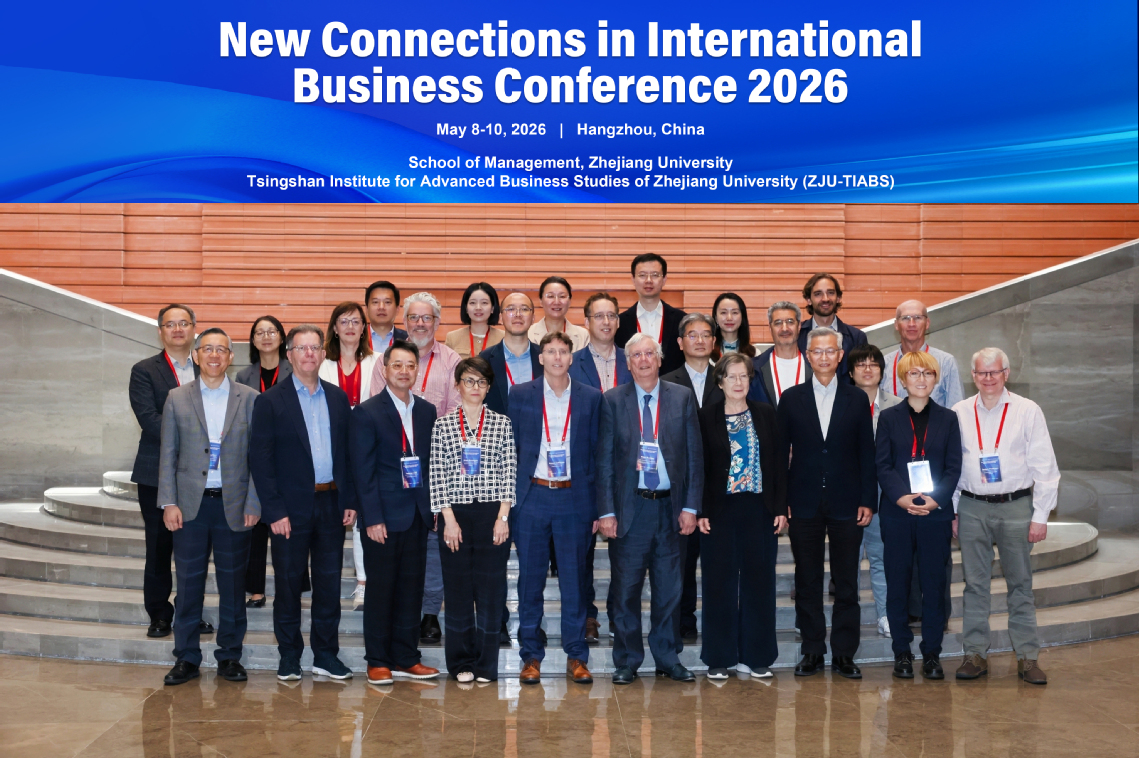
From May 8 to 10, 2026, the New Connections in International Business Conference 2026 (ZJU-IB2026) was held at the School of Management, Zijingang Campus, Zhejiang University, in Hangzhou. The conference focused on cutting-edge issues such as geopolitical disruptions, technological transformations, the reshaping of global investment landscapes, the resilience of multinational enterprises, and China’s role in the global innovation and international business system. Scholars and experts from renowned universities and research institutions around the world, including University of Cambridge (UK), University of Oxford (UK), University of Manchester (UK), University of Miami (USA), University of Melbourne (Australia), Bocconi University (Italy), Copenhagen Business School (Denmark), HKUST, CUHK, CityU, Peking University, Tsinghua University, Nanjing University, and Zhejiang University, among others, gathered in Hangzhou to engage in in-depth academic dialogues and intellectual exchanges on the conference theme. The conference concluded with great success.
The New Connections in International Business Conference was co-hosted by the School of Management, Zhejiang University and Tsingshan Institute for Advanced Business Studies of Zhejiang University (TIABS), and this is the inaugural edition of the conference. The conference was co-chaired by Professor Simon Collinson, Tsingshan Chair Professor and Professor at the School of Management, Zhejiang University, Fellow of the Academy of Social Sciences (UK), and Fellow of the Royal Society of Arts (FRSA), together with Professor Wu Xiaobo, Tsingshan Chair Professor and Professor at the School of Management, Zhejiang University, Distinguished Expert of Zhejiang Province, and Director of TIABS. The conference featured multiple sessions, including keynote speeches, a keynote panel forum, parallel paper sessions, a doctoral and early-career researcher paper development workshop, and a journal editors' forum.

Group Photo
01 OPENING CEREMONY
Professor Xiaobo WU delivered the opening address. Professor Wu first extended a warm welcome and sincere gratitude to all attendees. He pointed out that, in an era marked by the emergence of various challenges and ubiquitous global connections, traditional International Business is accelerating its transformation toward Global Business. The development of Zhejiang University actively testifies to this transformation. The university has consistently ranked among the global top 50 in the QS World University Rankings, achieved continuous improvements in both the quantity and quality of its publications, continuously expanded its international partnerships, steadily increased the number of inbound international students, and witnessed the TIABS achieve leapfrog development, becoming an important platform for globalization research and practice. Finally, he called for the establishment of genuine win-win cooperation, transforming connections scattered across every corner of the world into sustainable innovation drivers and shared prosperity.

Prof. Xiaobo WU from Zhejiang University delivered the opening address
Professor Simon COLLINSON hosted the opening ceremony of the conference and extended a warm welcome to the international guests and all participants. He pointed out that the conference aims to facilitate discussion and collaboration, foster new international partnerships, and enhance cross-cultural understanding in the context of rising anti-globalization sentiments. The two core objectives of the conference are: first, to recognize, celebrate, and help nurture the growing contribution of Chinese scholars to the field of international business (IB), particularly doctoral students and early-career researchers; and second, to call on participants to apply IB theories, analytical frameworks, and methods to generate practical insights for businesses, governments, and stakeholders in addressing the challenges of the current highly uncertain environment. He further emphasized that, despite facing challenges, the Chinese economy continues to grow at around 5 percent, sustained by its evolving national innovation system as well as its high-quality institutions and governance structures. Zhejiang Province, where Zhejiang University is located, is an important innovation hub, and its entrepreneurial spirit and close ties with leading regional companies make it an ideal venue for this conference.

Prof. Simon COLLINSON from Zhejiang University hosted the opening ceremony
02 KEYNOTES
Arranged in order of presentation
The first session of the keynote speeches was hosted by Professor Simon COLLINSON, Fellow of the Academy of Social Sciences (UK, FAcSS), Fellow of the Royal Society of Arts (UK, FRSA), Tsingshan Chair Professor at Zhejiang University, and Professor at the School of Management, Zhejiang University.

Prof. Simon COLLINSON from Zhejiang University hosted the speech
Professor Peter BUCKLEY from the University of Manchester delivered a speech titled “Times Change: The Development of COFDI and International Business Theory: 2007-2027”. Taking his 2007 classic study on the determinants of China’s outward FDI as a starting point, he systematically reviewed the development trajectory of China’s outward FDI over the past two decades, pointing out that, in the context of intertwining geopolitical shocks, technological changes, and economic fluctuations, the resilience and adaptive capabilities of multinational enterprises are facing entirely new challenges. He noted that China has grown from a “cautious starter” in outward investment into a leading global player in outward FDI, and has gradually emerged as a global innovation powerhouse. At the same time, international business theory continues to evolve, with research perspectives shifting from the traditional “boardroom view” toward a more macro and systemic “bird’s eye view”.

Prof. Peter BUCKLEY from the University of Manchester delivered a speech
Professor Yadong LUO from the University of Miami delivered a speech titled “Geo-strategies for International Business.” Focusing on the issue of geostrategy in international business against the backdrop of an accelerating restructuring of the global order, he pointed out that the global system is shifting from “rule-based openness” to “power-based protectionism”, and that multinational enterprises need to move from an efficiency-driven logic of globalization toward a strategic model that places greater emphasis on resilience, pragmatism, and multipolar positioning. He proposed key propositions such as “limited interdependence”, “multiple rationalities”, and “universal guardrails”, and introduced the 3R framework (recalibration, resilience, regionalism) to guide corporate strategic adjustments. He emphasized that firms should not only enhance their ability to shield themselves from external shocks but also seize new opportunities in a turbulent environment, and outlined a future research agenda centered on meta-intelligence, regionalization, and adaptive global strategies.

Prof. Yadong LUO from the University of Miami delivered a speech
Keynote Roundtable
The roundtable discussion session was hosted by Professor Wim VANHAVERBEKE from the University of Antwerp, focusing on national capacity building for innovation, geopolitical implications, and strategic adjustments of multinational enterprises in the context of disruptive changes. Prof. Torben PEDERSEN, Prof. Grazia SANTANGELO, Prof. Jiatao (JT) LI, and Dr. Zhijian HU engaged in in-depth discussions on topics such as building a science and technology powerhouse, corporate legitimacy, multi-localization strategies, and firm resilience and risk responses. The discussion covered the profound impact of geopolitics on innovation systems and open collaboration, the role of universities and research institutions in supporting industrial and national development, multi-localization strategies of MNEs amid political tensions, and how firms can transform global disruptions into development opportunities. The participating experts agreed that, in an international environment characterized by rising uncertainty, innovation capacity, open cooperation, and strategic resilience are becoming critical pillars of national competitiveness and the sustainable development of enterprises.

Prof. Wim VANHAVERBEKE from the University of Antwerp hosted the roundtable forum
Professor Torben PEDERSEN from Copenhagen Business School delivered a speech titled “Global Disruptions and Corporate Resilience”. He pointed out that contemporary firms operate in a complex global environment shaped by the interplay of geopolitical instability, technological transformation, climate risks, and regulatory uncertainty. Focusing on how global disruptions reshape the business environment for firms, he systematically analyzed the organizational capabilities required to anticipate, absorb, adapt to, and recover from systemic shocks. He emphasized that firm resilience is a multidimensional concept, encompassing not only risk management but also key capabilities such as agile leadership, business diversification, digital readiness, financial flexibility, and stakeholder trust. By integrating strategic analysis with practical cases, he argued that truly resilient firms are not only better equipped to withstand uncertainty but also more likely to identify and seize new development opportunities amid turbulence.

Prof. Torben PEDERSEN from Copenhagen Business School delivered a speech
Professor Grazia SANTANGELO from Copenhagen Business School delivered a speech titled “Same Storm, Different Compasses: How MNEs Navigate Geopolitical Pressures”. She focused on the global operational adjustments of multinational enterprises against the backdrop of rising geopolitical pressures, pointing out that, even when facing the same geopolitical storm, different firms adopt divergent coping strategies, and the policy responses of different governments also vary significantly. She emphasized that corporate strategies and policy trajectories are currently accelerating their divergence between the East and the West. This phenomenon, she noted, prompts the academic community to further reflect on whether what we are witnessing is merely a set of different responses by countries and firms to the same geopolitical pressures, or whether the very logic of globalization itself is undergoing a deeper fragmentation and restructuring.

Prof. Grazia SANTANGELO from Copenhagen Business School delivered a speech
Professor Jiatao (JT) LI from The Hong Kong University of Science and Technology (HKUST) delivered a speech titled “MNEs’ Strategic Responses to Geopolitical Tensions: A Dual Legitimacy Perspective.” He analyzed the strategic responses of MNEs under bilateral political tensions, pointing out that geopolitical tensions are increasingly reshaping how MNEs are evaluated in both home and host environments, turning ordinary business decisions into politically charged signals of alignment. On this basis, he proposed a “bilateral legitimacy” perspective and introduced the concept of the “dual legitimacy dilemma”, which arises when high geopolitical tension coincides with high host country dependence, making legitimacy demands sharply contradictory while rendering losses in the host country market difficult to absorb. This study offers a new analytical framework for understanding the strategic balancing of MNEs in complex political environments.

Prof. Jiatao (JT) LI from The Hong Kong University of Science and Technology delivered a speech
Dr Zhijian HU, President of the Chinese Association for Science of Science and S&T Policy Research, delivered a speech titled “China’s Current Stage and the Its Prospects of Building Itself into a Leader in Science and Technology”. He systematically presented the phased progress and future directions of China’s drive to become a leader in science and technology, pointing out that, based on the overall performance of primary and fundamental indicators, China excels particularly in three areas: “innovation resources”, “knowledge creation”, and “corporate innovation”. He further proposed five tasks for building a science and technology powerhouse, including: fully leveraging the advantages of the new type of nationwide system to accelerate the realization of high-level self-reliance and strength in science and technology; promoting the deep integration of scientific and technological innovation with industrial innovation to help develop new productive forces; deepening the reform of the science and technology management system to unleash innovation and creativity; coordinating the development of education, technology, and talent to build a competitive edge in human resources; and acting on the vision of a community with a shared future for mankind to advance open international cooperation in science and technology.

Dr. Zhijian HU, President of the Chinese Association for Science of Science and S&T Policy Research, delivered a speech
This roundtable forum not only responded to the real-world challenges arising from the ongoing restructuring of global geopolitics and the world economy, but also further highlighted the significance of innovation-driven development, open collaboration, and resilient governance. From Dr Zhijian HU’s reflections on building China’s strength in science and technology alongside high-level opening-up, to Professor Jiatao (JT) LI’s analysis of corporate legitimacy and multi-localization strategies, to Professor Grazia SANTANGELO’s examination of different logics of globalization, and Professor Torben PEDERSEN’s insights on how firms can seize disruptive opportunities while enhancing risk management capabilities—all these contributions provided important lessons for understanding how nations and enterprises can achieve robust development in a disruptive era. The participants agreed that in the face of a complex and volatile global environment, only by continuously strengthening innovation capacity, improving governance mechanisms, and deepening open cooperation can we better respond to shocks, seize opportunities, and advance both national development and international business practice toward higher-quality stages.

Keynote Roundtable Discussion Session
The second session of the keynote speeches was moderated by Can HUANG, a professor at the School of Management, Zhejiang University, Director of the Zhejiang Provincial Research Base for Data Intellectual Property, and Executive Deputy Director of the Research Center for Innovation Management and Sustainable Competitiveness at Zhejiang University.

Prof. Can HUANG from Zhejiang University hosted the speech
Professor Changqi WU from Peking University delivered a speech titled “Evolution of International Business Research and Education in China: The Past, Present and Future”. He pointed out that China has become an important arena for the development of international business, serving both as a major site of global business activity and as a key context for talent development. China is not only an empirical setting for international business research, but also an emerging source of IB theorizing and educational innovation. The future of the field lies in translating Chinese business experience into globally meaningful theories and educational curriculum designs.

Prof. Changqi WU from Peking University delivered a speech
Professor Xufei MA from The Chinese University of Hong Kong delivered a speech titled “Charting Global Complexity: An Agenda for Using Global Event Databases in International Business Research”. He pointed out that a notable development in recent international business research is the growing potential of global event databases. However, a critical observation is that current IB research still relies heavily on traditional data sources, which limits its ability to explain today’s turbulent international environment and to generate more timely and practically relevant insights. By contrast, some emerging databases have begun to use unstructured news text to systematically capture key event information such as “who did what to whom, as well as when and where”. By comparing traditional and emerging databases, he explored several promising directions for the future use of databases in IB research.

Prof. Xufei MA from The Chinese University of Hong Kong delivered a speech
Professor Jane Lu from City University of Hong Kong delivered a speech titled “When Geopolitics Fractures Global Innovation”. She pointed out that although global innovation networks enable multinational enterprises to access talent and resources worldwide, thereby enhancing innovation performance, this strategy also faces significant risks against the backdrop of rising techno-nationalism. Geopolitical tensions reduce MNEs’ innovation output, particularly for those that rely heavily on internal linkage strategies. Using inventor-level data and a difference-in-differences approach, she found that geopolitical risks disrupt internal linkages primarily by undermining cross-border research team collaboration and talent mobility. Moreover, such disruptions propagate through inventor networks, reducing the productivity of domestic inventors connected to affected international collaborators. The study reveals that, in an increasingly fragmented geopolitical landscape, global R&D networks can shift from valuable assets to systemic vulnerabilities.

Prof. Jane LU from the City University of Hong Kong delivered a speech
The conference provided a highlevel academic exchange platform for scholars from home and abroad, featuring indepth dialogues on cuttingedge issues of international business in a changing world through diverse formats.
Live Photo Gallery:https://m.alltuu.com/album/953a5e3e6a304440b15c160ed81a9fbc/?menu=live
Prof.Yadong Luo' slides on 9th May: KN 2 Luo Geo-strategies 2026.pdf
Prof.Changqi Wu' slides on 10th May:20260510 Evolution of IB research and education in China Changqi Wu.pdf